Brett Z.
Say hello
← home/Case study / 02

RoboRatings

A data-driven shopping platform for robot vacuums — built end-to-end with AI-assisted development, programmatic SEO, and a self-auditing content loop.

2025 — Now · Atlanta
Next.js / VercelProgrammatic SEOAI content loopAutomated socialRemotion video
Claude Code
Built with
100+
Products analyzed
5K+
Data points tracked
8+
Brands covered
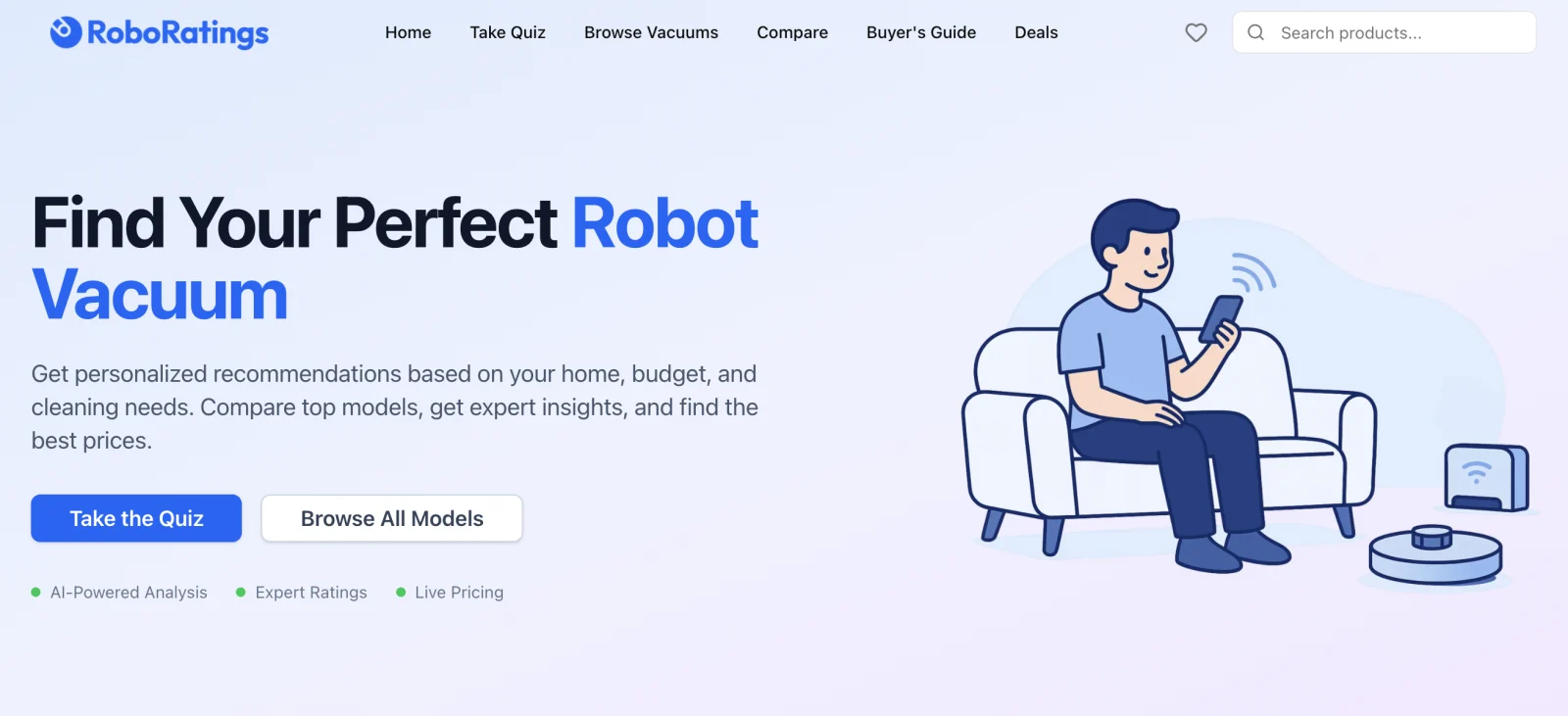
RoboRatings homepage
01Overview

An affiliate site that acts like a real product team.

RoboRatings is a robot-vacuum shopping platform at roboratings.com. It helps shoppers find the right robot vacuum through AI-powered rankings, side-by-side comparisons, a personalized quiz, a buyer's guide, and live pricing across retailers.

It's an affiliate business — revenue comes from referrals to Amazon and other retailers — but it's operated like a venture-backed product team. The content engine, the SEO auditor, the social scheduler, and the programmatic video pipeline were all built with Claude Code and run on a self-improving loop.

impact
0 → shipped
Ground-up build in weeks, not months
impact
100+
Products analyzed and scored
impact
Solo
Operated by one person with AI
02AI-built stack

Claude Code wrote most of the platform.

problem
A single operator can't compete with established review sites that have dozens of writers, editors, and engineers. The math just doesn't work.
approach
Flip the ratio — let AI do the writing, engineering, and QA under a tight review loop. Use Claude Code as the primary IDE: it pair-programs the Next.js codebase, handles data modeling, writes migrations, and ships features end-to-end.
outcome
A production affiliate platform that would conventionally need a small team is built and operated solo. New features ship same-day. Content scales without a content team.
RoboRatings top-rated products section
03AI content + programmatic SEO

A programmatic SEO engine grounded in real product data.

The content engine is the core differentiator. A product-knowledge base — specs, features, pricing history, review extracts, category context — feeds a set of page templates: individual product reviews, head-to-head comparisons, category guides, “best X for Y” lists, and informational articles.

Every page is generated from the same grounded data, so scores and specs stay consistent across the site. Pages auto-refresh when pricing or availability changes, and the LLM layer enriches content with buyer intent — features that matter most to pet households, rentals, large-home layouts, etc.

RoboRatings buyer's guide and category structure
impact
1 KB
Per product — single source of truth
impact
5+ formats
Generated from the same data
impact
Auto-refresh
Prices + availability stay live
04Self-auditing SEO pipeline

A crawler + LLM pair that finds its own problems.

problem
Programmatic SEO scales fast — and fails fast. Thin content, duplicate titles, missing schema, broken internal links, category pages that under-index intent… any one of these at scale tanks ranking.
approach
Built an internal auditor: a crawler that walks the sitemap, extracts on-page signals + rendered content, then hands each URL to an LLM for scoring against an intent rubric. Issues come back as a diff-ready change list — PR-worthy, not just a dashboard.
outcome
Audit runs on a schedule. Regressions get caught before they metastasize. The site improves without needing a dedicated SEO hire.

The auditor doesn't just tell me what's wrong — it writes the fix as a diff I can review and merge.

05Automated social distribution

A multi-account scheduler with AI-generated captions and visuals.

Social is a funnel for the site, but manually posting across multiple accounts and platforms eats hours. The scheduler — built on a self-hosted Postiz stack — pulls from a queue of product rankings, comparison highlights, and buyer-guide snippets, generates the caption + visual variant per platform, and posts on a cadence.

Content is keyed to product launches and ranking changes on the site. When a new vacuum crosses into the top-10, it triggers a series of cross-platform posts automatically.

06Programmatic video

Turning a product spec sheet into a branded short.

Short-form video drives a disproportionate share of discovery — but producing one per product is expensive. The pipeline takes a product's knowledge base, generates narration, pulls product imagery, stitches scenes together in Remotion, and renders a branded short ready for TikTok / Reels / Shorts.

Because it's Remotion, every video uses the same motion-design language — the brand stays consistent even when the content is entirely automated.

RoboRatings trust signals and product data scale
07Personalization

A quiz that actually understands what you need.

Most affiliate quizzes are decorative — they nudge you toward whatever pays the best commission. This one is real. The shopper answers questions about their home, pets, floor types, budget, and priorities; the recommendation engine scores the full catalog against those constraints and returns a ranked shortlist with explanations.

RoboRatings quiz and call-to-action sections
Next case study / 01

Matterform

read case study →

The private-label home goods brand that runs across five channels — Amazon, an AI-coded Shopify storefront, Walmart, Etsy, and eBay.

✦ open to workremote only
06 / Contact

Let's build
something good.

Open to new opportunities in AI + eCommerce. Atlanta-based, remote only. Best at 0→1 product work with AI doing real work under the hood.

or drop a note →