
Brett Z.
Say hello
← home/Case study / 01

Matterform

A private-label home goods brand built around AI-assisted product development, omni-channel distribution, and a purpose-built internal ERP.

2020 — Now · Atlanta
Amazon FBAShopify · Walmart · Etsy · eBayAI-coded storefrontCAD / product devInternal ERP
6-figure
Annual revenue
40%
YoY growth (2025)
5
Sales channels
5+
Years operating
Matterform homepage
01Overview

What started as a side project is now an omni-channel operating business.

Matterform is a private-label home goods brand I founded in 2020. The catalog is designed, prototyped, and — for most SKUs — manufactured in-house. What began as a single product on Amazon now ships across five channels: Amazon FBA (the flagship), an AI-coded Shopify storefront at matterform.io, plus Walmart, Etsy, and eBay stores.

Every part of the operation — product development, manufacturing, listing creation, ad management, forecasting, fulfillment — is a lever I pull personally. AI is the force multiplier that makes a one-person operator competitive with brands that have a full team behind each function.

impact
6-figure
Annual gross revenue
impact
40% YoY
Growth rate in 2025
impact
5 channels
Amazon · Shopify · Walmart · Etsy · eBay
02Product design & manufacturing

Every SKU is designed, prototyped, and manufactured in-house.

problem
Sourcing through typical private-label channels meant long lead times, thin margins, and cookie-cutter products with no real differentiation.
approach
Use CAD + 3D printing to compress the design-to-ship loop. Every product starts as a Fusion 360 model, iterates through 3D-printed prototypes, and ships in small-batch production runs I operate directly.
outcome
Weeks-to-market instead of months. I can ship a new SKU before most sellers finish a sourcing request. Margin structure is healthier because there's no middle layer.
Matterform product detail page — Top Loader & Penny Sleeve Dispenser
03Omni-channel distribution

Amazon pays the bills. The other four channels compound the brand.

Amazon FBA is still the biggest revenue channel and handles the fulfillment heavy-lifting. But concentration risk is real, so I've built out four additional channels — each with its own listing strategy, image set, and pricing model.

  • Amazon FBA — flagship channel, automated replenishment, Brand Registry protection.
  • Shopify (matterform.io) — the direct-to- consumer home. Entirely AI-coded — see next chapter.
  • Walmart Marketplace — secondary marketplace for the products that over-index there.
  • Etsy— strong for the hobbyist & handmade-adjacent SKUs.
  • eBay — surprisingly productive for collector / niche items, low overhead to maintain.

The thing that makes five channels feasible as a solo operator is the AI-assisted content pipeline: I generate channel-specific listings, images, and keywords from a single source of truth per product.

04AI-coded Shopify storefront

matterform.io was built end-to-end with AI-assisted development.

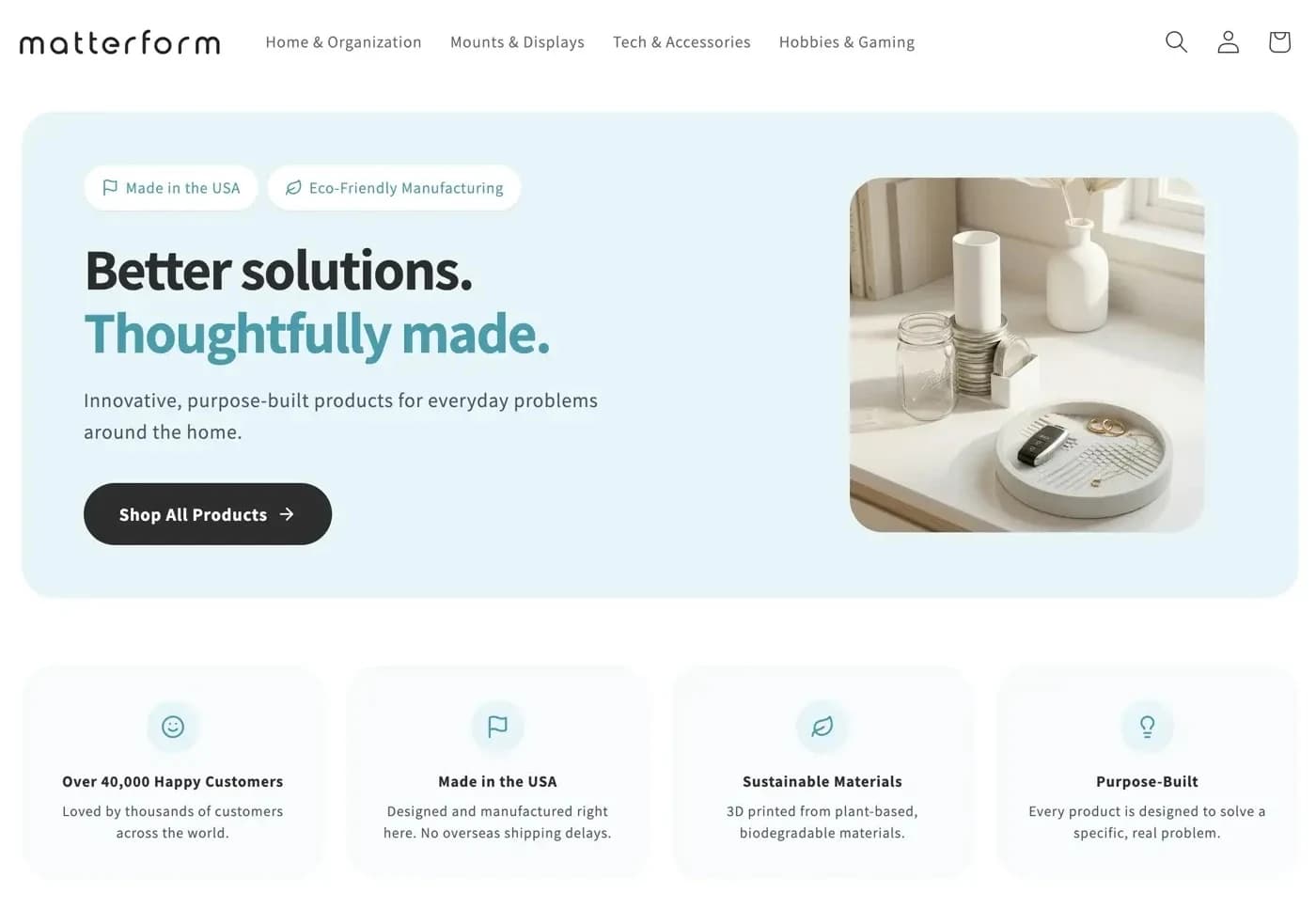
The Shopify theme, catalog structure, collection pages, PDP design, email flows, and SEO schema markup were all built with Claude Code pair-programming. I didn't buy a template — the theme is custom Liquid/HTML/CSS that I own end-to-end.

That lets me do things template-buyers can't: changing a component is a one-prompt operation, the schema audit is automated, and adjustments propagate across every PDP in minutes instead of hours.

matterform.io homepage
05AI marketing assets

A content pipeline that turns one product into dozens of channel-specific assets.

problem
Every SKU needs a distinct listing per channel — different title structures, image aspect ratios, and keyword targeting. Doing this by hand at 70+ SKUs is a full-time job.
approach
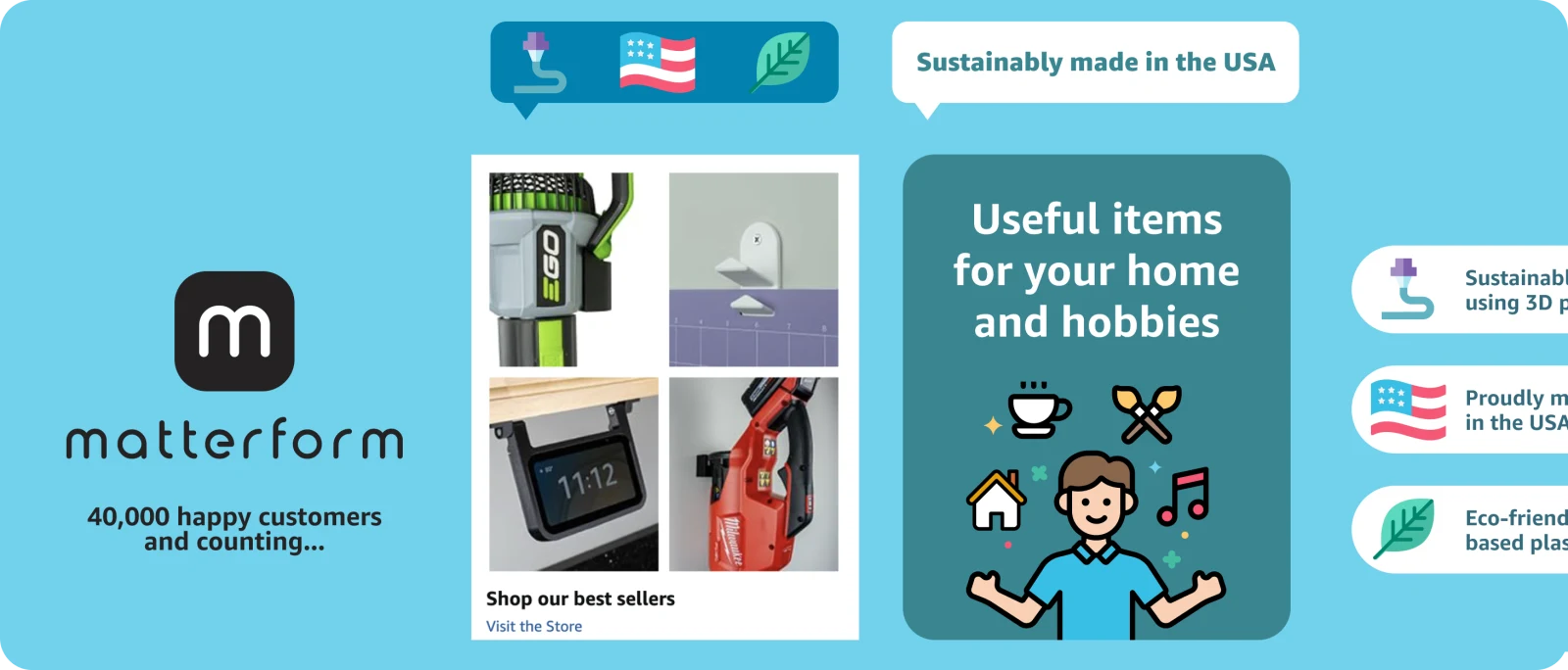
AI generation, grounded in a single product-knowledge-base per SKU. The pipeline produces listing copy, lifestyle images, A+ content, and FAQ blocks in the formats each channel expects.
outcome
A launch-ready product package is minutes away, not days. I spend the saved time on actual product decisions instead of copywriting.
impact
~5 min
From finished SKU to listing-ready
impact
Channel variants generated per product
impact
One KB
Per SKU — single source of truth
06Internal ERP

A purpose-built ERP runs the physical side of the business.

Stock-out risk was expensive — every out-of-stock day on Amazon compounds into lost ranking. Off-the-shelf ERPs either cost thousands per month or didn't fit a model where I manufacture most of my own inventory on a small print farm.

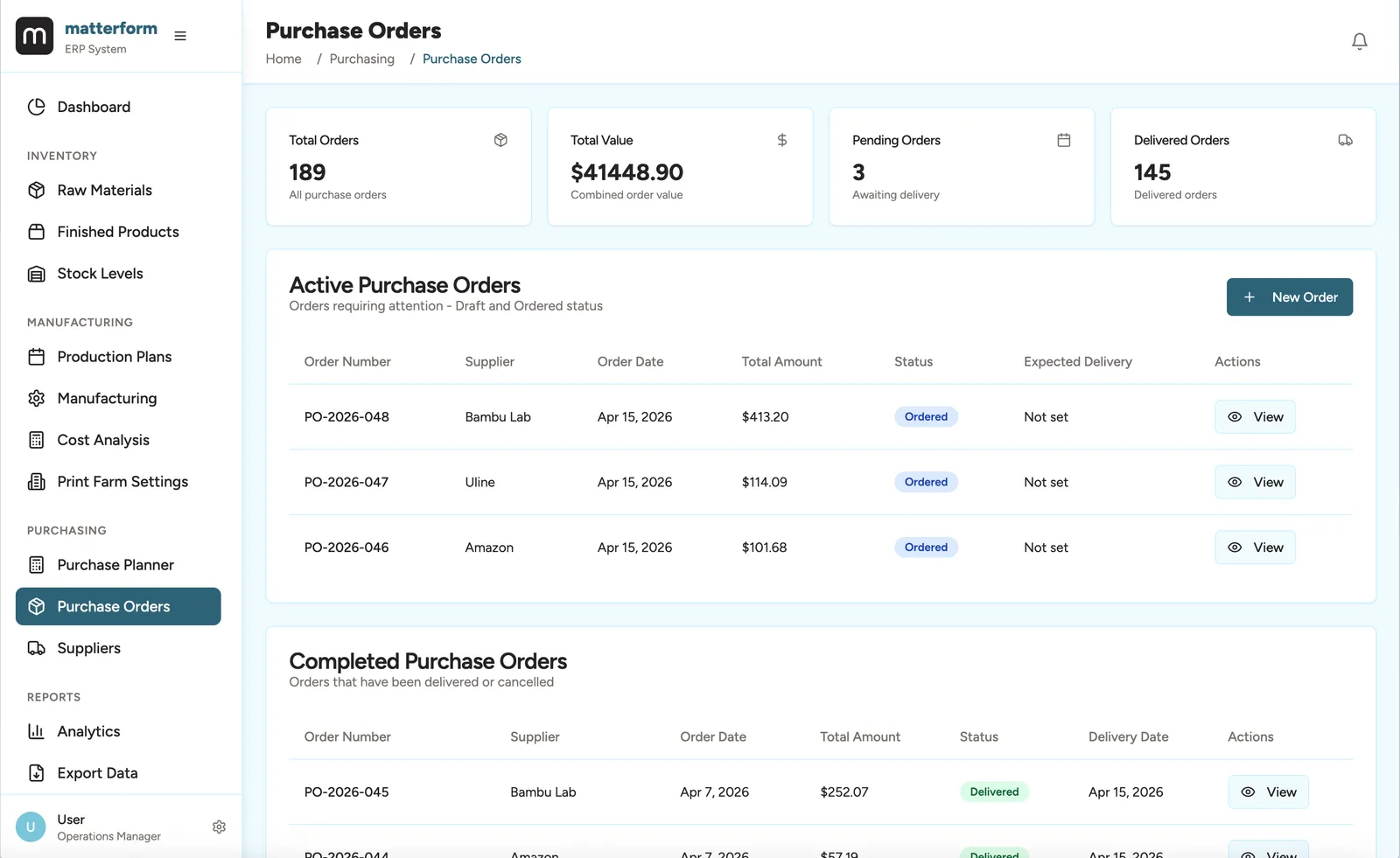
So I built my own. It tracks raw materials, finished goods, bills of materials, and runs weekly production plans against inventory forecasts. It also manages purchase orders and inbound shipments into FBA. Built with AI-assisted development in a few weeks of evenings.

ERP — Stock levels
Stock Levels · in-stock / low-stock / out-of-stock with reserved-quantity tracking
ERP — Production plans
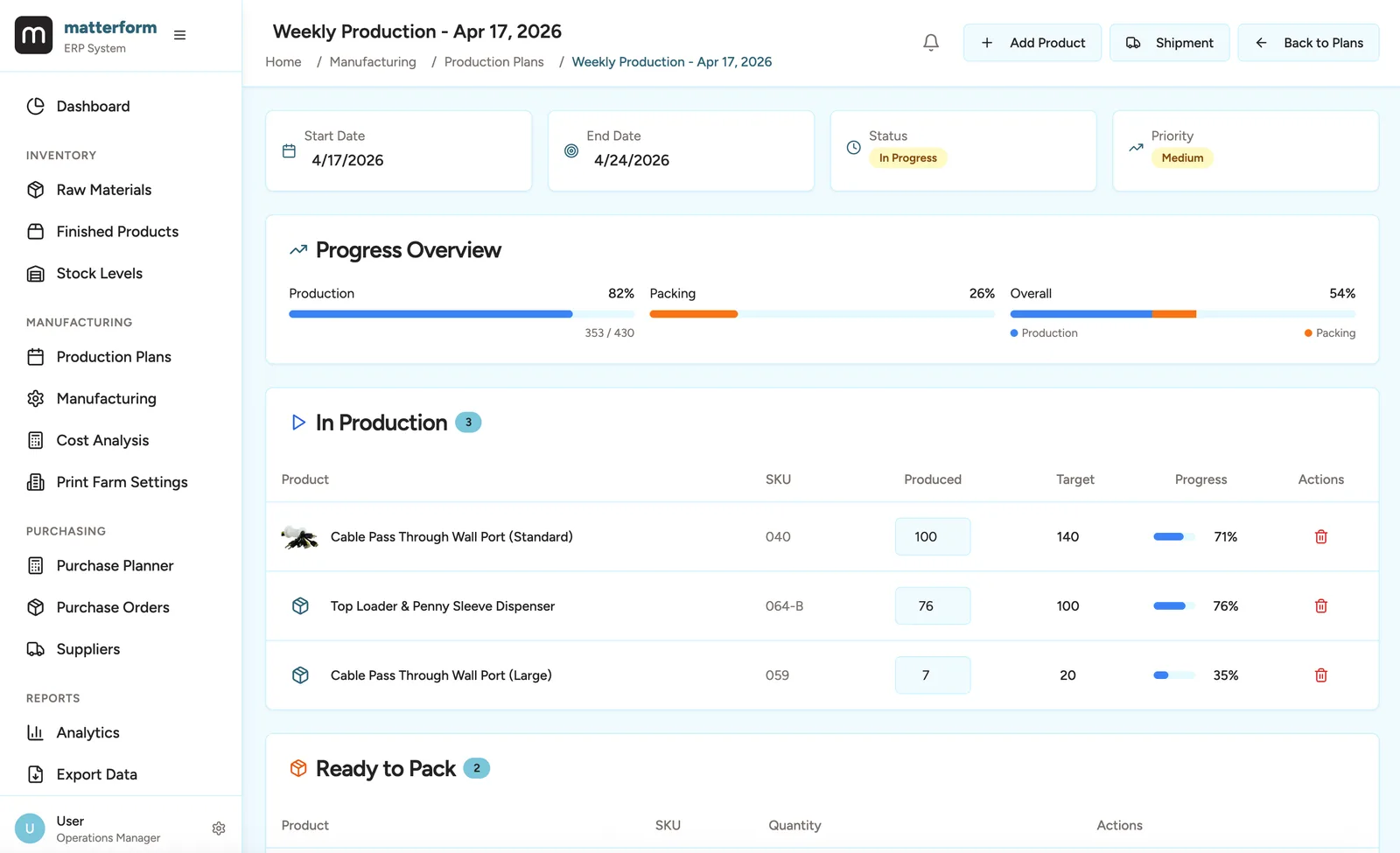
Production Plans · weekly batch plans with progress + priority
ERP — Purchase orders
Purchase Orders · supplier tracking across Bambu Lab, Uline, Amazon, etc.
ERP — Weekly production drill-down
Weekly drill-down · production vs packing progress by SKU
07PPC audits & optimization

A repeatable system for finding waste in Amazon ad spend.

problem
Amazon Ads accumulates waste quickly — expensive search terms that don't convert, bleed-through between exact/phrase/broad, underperforming ASINs dragging down portfolio ACoS.
approach
LLM-assisted audit pipeline: pull search-term, placement, and portfolio reports weekly; have an agent tag waste, high-performers, and negatives; produce a bulk-upload file ready to paste into Amazon's Campaign Manager.
outcome
Audits that used to take 2–3 hours now run in a few minutes of review. Negative keyword lists stay fresh. Portfolio ACoS stays in a healthy range without manual micromanagement.

The AI does the tedious spreadsheet work; I make the judgement calls. That's the whole system.

08Product launch kits

Every new SKU ships with a complete launch kit generated from its knowledge base.

A launch kit is the full package a product needs to go live everywhere: titles, bullets, descriptions, image prompts, A+ content blocks, keyword lists per channel, pricing recommendations, and a short-form video script.

I built a workflow that produces this kit from a single product knowledge base — so the story is consistent across channels, but the format is tailored to each one. What used to be a 2-day setup per SKU is now a 30-minute review.

impact
30 min
Time from product-ready to launch-ready
impact
1 KB
Product knowledge base drives everything
impact
5 channels
Format-matched variants per SKU
Next case study / 02

RoboRatings

read case study →

An AI-built robot-vacuum shopping platform with a programmatic SEO loop and automated social distribution.

✦ open to workremote only
06 / Contact

Let's build
something good.

Open to new opportunities in AI + eCommerce. Atlanta-based, remote only. Best at 0→1 product work with AI doing real work under the hood.

or drop a note →